
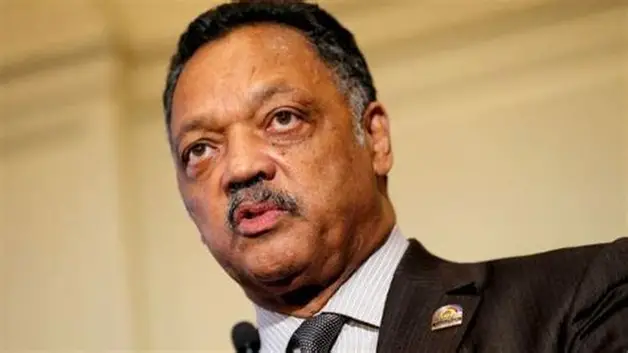
Jesse Jackson, a prominent figure in the fight for civil rights, has had a long and impactful career, yet his net worth is estimated at around $4 million. This might come as a surprise to many, considering his influential role in social justice movements.
Jackson’s journey began in the 1960s, working alongside leaders like Martin Luther King Jr. His dedication to equality and justice has defined his life’s work, but it hasn’t always translated into financial success.
Throughout the years, he has founded organizations like the Rainbow PUSH Coalition, which advocates for civil rights and economic equity. However, the financial struggles of nonprofit work often mean that leaders like him don’t accumulate wealth in the same way as those in the private sector.
What was Jesse Jackson’s Net Worth and Salary?
Jesse Jackson is a well-known civil rights leader and public figure. His estimated net worth is around $4 million USD, reflecting his long career in activism and leadership.
In the 1980s, his family’s assets were valued between $400,000 and $600,000, which would be approximately $1.2 million to $1.7 million today. By 2001, Jackson’s reported salary from the organizations he led was about $120,000 per year.
He also earned $5,000 weekly from his CNN show, “Both Sides with Jesse Jackson.” During the mid-1980s, his income was around $200,000 per year from personal business and fees for speaking engagements, especially connected to his presidential campaigns.
His income has come from various sources, including speaking fees, leadership roles in civil rights organizations, television work, and book royalties. While estimates vary slightly, most sources calculate his net worth to be around $4 million, showing how his earnings have changed over the years based on his public activities.
Financial Disclosures
In March 2001, Jesse Jackson shared details of his personal finances. He reported earning about $120,000 yearly from the organizations he led. Additionally, he received $5,000 each week from hosting his show, Both Sides with Jesse Jackson, on CNN. His travel expenses, as reported by his organizations, totaled a significant $614,000, with $450,000 reimbursed by the Democratic National Committee (DNC).
Going back to 1987, Jackson’s financial disclosure showed that his family’s assets were valued between $400,000 and $600,000. When adjusted for inflation, that’s roughly $1.2 million to $1.7 million in today’s dollars.
Jackson is closely tied to various nonprofits, which reveal financial details in their IRS filings. For instance, the Citizenship Education Fund’s 2022 IRS Form 990 shows total revenue of around $3.4 million and expenses of about $4 million. The fund reported Jackson’s executive compensation as $177,056.

While he appears as an unpaid director in some foundation filings, such as the Jackson Foundation, these documents mainly disclose organizational assets and liabilities, without detailing any personal pay to Jackson. Personal financial disclosures typically do not specify ownership of businesses or investments, only providing ranges for assets and necessary income details.
Early Life
Jesse Louis Burns was born on October 8, 1941, in Greenville, South Carolina. Growing up during the Jim Crow era, he faced the harsh realities of segregation and discrimination, which deeply influenced his later activism. After being adopted by his stepfather, Charles Jackson, he changed his name, marking a new chapter in his life.
As a young man, Jesse became a leader among his peers when he organized the Greenville Eight protest, which led to his first arrest for civil rights. He was not only a passionate activist but also a talented athlete and scholar at Sterling High School. His skills on the football field earned him a scholarship to the University of Illinois. However, he later transferred to North Carolina A&T, where he earned a Bachelor’s degree in sociology.
While in college, Jesse actively participated in sit-ins and protests, further deepening his commitment to civil rights. After completing his education, he pursued graduate studies at the Chicago Theological Seminary and became an ordained Baptist minister. During this time, he married Jacqueline Brown, starting a family life that ran parallel to his activism.
Education
He attended Greenville public schools and received a football scholarship to the University of Illinois in 1959. He later transferred to North Carolina A&T State University, where he earned a B.A. in sociology in 1964, serving as quarterback and student body president. From 1964 to 1966, he pursued graduate studies at the Chicago Theological Seminary but left to engage in full-time civil rights work. He was ordained as a Baptist minister in 1968, later receiving a Master of Divinity from the Chicago Theological Seminary.
Civil Rights Activism
Jesse Jackson engaged in civil rights activism beginning in the 1960s at North Carolina A&T State University, participating in sit-ins and protests and joining the Southern Christian Leadership Conference (SCLC) in 1965. He closely collaborated with Martin Luther King Jr. and became national director of Operation Breadbasket, advocating for economic justice in Black communities.
In the 1970s, he founded Operation PUSH, focusing on corporate accountability, minority hiring, and voter registration.
In the 1980s, he established the National Rainbow Coalition to unite various marginalized groups for voting rights and social justice. Jackson ran for president in 1984 and 1988, gaining significant support. His international efforts included negotiating hostages’ release and opposing apartheid. He merged PUSH and Rainbow Coalition in 1996, addressing criminal justice reform and education access.
Political Career
Jesse Jackson gained national recognition in the 1960s through the SCLC and his partnership with Martin Luther King Jr. He led economic justice initiatives in Chicago and founded Operation PUSH in 1971 to boost political influence in urban areas. In the 1984 Democratic primaries, he founded the National Rainbow Coalition, winning Louisiana and securing 3.3 million votes, though finishing third. His efforts significantly increased minority voter participation.
In 1988, Jackson ran again, winning 11 primaries and receiving over 6.9 million votes, finishing second. He influenced the Democratic Party’s platform to support expanded voter rights and social justice. As Illinois’s first African American male U.S. Senator from 1991 to 1993, Jackson served on labor and urban affairs committees but did not seek a full term. His international diplomacy included missions to Syria and Cuba, and he advocated against apartheid in South Africa.
Media and International Work
Jesse Jackson hosted “Both Sides with Jesse Jackson” (early 1990s) on CNN and a radio program, “Keep Hope Alive.” He frequently appeared as a political commentator on networks like CNN and MSNBC and delivered keynote speeches at the Democratic National Conventions in 1984, 1988, 1992, and 2000. Notable events include negotiating the release of U.S. Navy pilot Lt.
Robert Goodman from Syria in 1984, meeting with Hafez al-Assad, and securing the release of 22 American prisoners from Cuba after speaking with Fidel Castro. In 1990, amidst the Iraq/Kuwait Crisis, he obtained the release of hostages in Iraq. Jackson also opposed apartheid, supported sanctions against South Africa, and advocated for Nelson Mandela’s release.
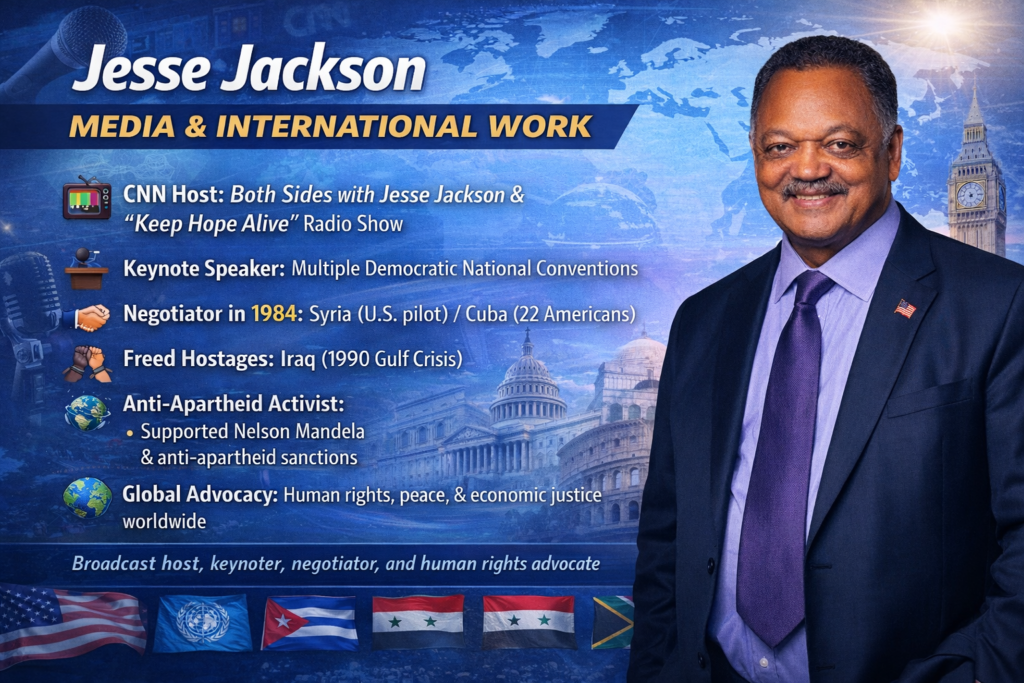
He engaged in global advocacy for economic justice, human rights, and voting rights expansion, working through the Rainbow PUSH Coalition to promote social justice initiatives.
Personal Life & Death
Jesse Jackson was born on October 8, 1941, in Greenville, South Carolina. He went on to marry Jacqueline Brown in 1962, and together they built a large family.
The couple had six children, one of whom is Jesse Jackson Jr., a prominent politician. In 2001, Jesse made headlines when he publicly acknowledged his daughter, Ashley Jackson, further expanding his family’s story.
In 2017, Jesse faced a significant health challenge when he was diagnosed with Parkinson’s disease, a condition that affects movement and can be quite difficult to manage. Despite these challenges, he showed resilience, recovering from COVID-19 in 2021.
Sadly, Jesse Jackson passed away on February 17, 2026, at the age of 84. His life was marked by both personal and public achievements, leaving a lasting impact on many.
Conclusion
Jesse Jackson’s net worth of $4 million reflects his long and impactful career as a civil rights leader and activist. Over the years, he has worked tirelessly to promote social justice and equality, earning respect and admiration from many. Despite facing challenges, Jackson has remained dedicated to his cause, using his platform to raise awareness and encourage change. His financial success is a testament to his hard work and determination. If you want to learn more about influential figures like Jesse Jackson, take some time to explore their stories and contributions.
FAQs
What is Jesse Jackson’s estimated net worth?
Jesse Jackson’s net worth is estimated to be around $4 million.
How did Jesse Jackson earn his money?
He earned money through his work as a civil rights activist, politician, and founder of several organizations.
Has Jesse Jackson always been wealthy?
No, Jesse Jackson started from humble beginnings and built his wealth over many years of dedication to civil rights and political work.
What other ventures has Jesse Jackson been involved in?
Apart from activism, he has been involved in public speaking, writing books, and running nonprofit organizations.
What legacy does Jesse Jackson leave behind?
Jesse Jackson’s legacy includes raising awareness about racial equality and fighting for social justice.